

Sana Farooqui leads product at a six-person logistics startup in Karachi, and a year ago she faced a familiar squeeze. Investors wanted an iPhone app and an Android app, customers on both platforms were asking for tracking features, and her budget could fund exactly three engineers. Hiring separate iOS and Android teams was out of the question. She chose a single shared codebase instead, shipped both apps within four months, and spent the savings on better driver onboarding. Nobody who used the app could tell which parts were shared. They just noticed it worked.
Choices like Sana’s are why every serious Cross Platform App Development Company now treats shared code as a mainstream option rather than a compromise. The old assumption that cross-platform meant slow and clunky has faded. Frameworks matured, devices got faster, and businesses learned that reaching two platforms at once often matters more than squeezing out the last drop of native polish. This guide explains how the approach works, which tools lead the field, where it shines, where it struggles, and how the technology is reshaping the mobile world.
What “Cross-Platform” Actually Means
For years, building a mobile app meant writing it twice. iOS apps used Objective-C and later Swift with Apple’s tools. Android apps used Java and later Kotlin with Google’s. Two codebases, two teams, two sets of bugs, two release schedules.
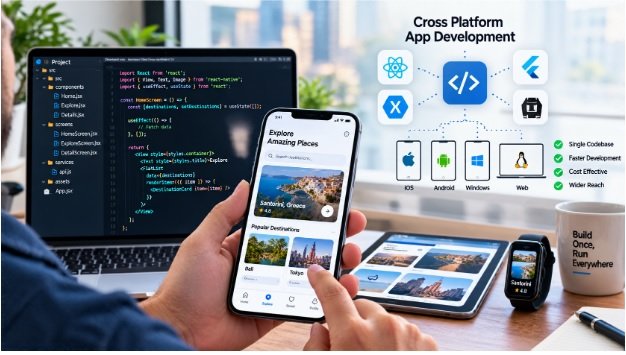
Cross-platform development flips that model. Developers write most of the app once, using a single framework, and the same code runs on both iOS and Android. Many frameworks also target web and desktop, so a single project might power a phone app, a tablet layout, and a browser version.
The goal isn’t to erase the difference between platforms. Good cross-platform apps still respect each system’s conventions for navigation, gestures, and permissions. The point is to share everything that doesn’t need to differ, which is usually the majority of the app: business logic, data handling, network calls, and a large portion of the interface.
Why the Approach Took Off
Several forces pushed cross-platform tools from side projects into the mainstream.
Cost and speed. Maintaining one codebase typically costs less than two, and teams reach the market faster. Industry estimates often put savings in the range of thirty to forty percent for suitable projects, though the real number depends heavily on complexity.
Talent scarcity. Skilled native developers are in demand, and smaller companies can’t always hire both iOS and Android specialists. Cross-platform frameworks let web developers and general engineers contribute to mobile projects.
Consistency. Features, branding, and bug fixes land on both platforms at the same time. Customers on Android stop feeling like second-class users.
Hardware progress. Modern phones handle layers of abstraction with ease. Performance gaps that once mattered in 2012 shrank dramatically on today’s chips.
Startup economics. For young companies, validating an idea quickly is critical. A shared codebase supports faster experiments.
The Framework Landscape
A handful of tools dominate the conversation, each with its own philosophy.
Flutter. Created by Google and built on the Dart language, Flutter draws its own interface using a high-performance rendering engine instead of relying on native components. That gives designers pixel-level control and consistent visuals across devices. Companies like BMW and Google Pay have used it for major products, and its hot reload feature lets developers see changes in seconds.
React Native. Backed by Meta and written in JavaScript or TypeScript, React Native renders real native components. Its large community and familiarity to web developers make it popular. Shopify, Discord, Microsoft, and Meta’s own apps have used it. Its newer architecture reduces the old bridge bottleneck, improving speed and responsiveness. Expo, a toolkit built around React Native, simplifies setup, builds, and updates.
Kotlin Multiplatform. From JetBrains, this approach shares business logic across platforms while allowing fully native interfaces, or shared interfaces through Compose Multiplatform. Google has voiced support for it, and it appeals to teams already invested in Kotlin.
.NET MAUI. Microsoft’s successor to Xamarin lets C# developers target mobile and desktop from one project. It suits organizations already built around the Microsoft ecosystem.
Ionic and Capacitor. These use web technologies wrapped in a native shell, making them a fit for teams with strong web skills and simpler app needs.
Unity. Mainly a game engine, it also powers interactive 3D experiences across many platforms.
No single option wins every scenario. The right choice depends on your team’s skills, the app’s needs, and how much native feel you require.
How It Works Under the Hood
Understanding the technical models clears up many debates.
Some frameworks, like React Native, translate your code into real native UI elements. A button in your code becomes a genuine iOS or Android button, which keeps the look and feel close to the platform.
Others, like Flutter, bring their own rendering engine. Instead of asking the system to draw each button, Flutter paints every pixel itself. That delivers consistency and smooth animation, though it means the framework must keep up with platform design changes.
Kotlin Multiplatform shares the non-visual logic and lets each platform handle its own interface, giving a strong native feel at the cost of more platform-specific UI work.
Web-based approaches run inside a webview, which is simpler but can feel less fluid for demanding interfaces.
Whichever model you choose, platform channels or native modules allow your code to reach device features like the camera, biometrics, GPS, and Bluetooth. When a needed feature isn’t available, developers write a small piece of native code to bridge the gap.
Business Impact: Speed, Reach, and Maintenance
For companies, the biggest gift of shared code is focus. Instead of coordinating two teams that may interpret a feature differently, one team builds it once and tests it across devices.
Release cycles tighten. A fix for a checkout bug ships on both platforms the same day. Marketing can launch campaigns knowing every customer sees the same experience. Product managers gain a clearer view of progress, since there’s one roadmap instead of two.
Maintenance also gets simpler over time. Operating systems change every year, and each update can break something. With a single codebase, teams adapt once rather than twice. That doesn’t remove the work, but it reduces the duplication.
For Sana’s team, the benefit showed up in a surprising place: onboarding. New engineers learned one codebase, and a bug reported by an Android driver could be reproduced and fixed by someone who normally worked on iOS.
Building One: A Practical Roadmap
It’s the question people type into search bars every day: how to build a cross-platform mobile app The short answer is a process, not a tool. A sensible path looks like this:
- Define the problem and audience. Decide who the app serves, which platforms matter, and which features are essential for a first release.
- Choose a framework. Match it to your team’s skills, performance needs, and long-term plans. Prototype a risky feature in two options if you’re unsure.
- Design the experience. Sketch flows, create a design system, and decide where to follow platform conventions and where to keep a unified brand look.
- Set up architecture. Plan state management, navigation, data storage, and API layers. Clean structure early prevents painful rewrites later.
- Build a minimum viable product. Ship the core loop first, such as ordering, tracking, or booking, and leave extras for later.
- Integrate services. Connect backend APIs, authentication, payments, analytics, and push notifications.
- Test widely. Use real devices across screen sizes and operating system versions, plus automated tests and cloud device labs.
- Automate delivery. Continuous integration tools like GitHub Actions, Codemagic, Bitrise, Fastlane, or Expo’s build services speed up builds and releases.
- Publish. Prepare App Store and Google Play listings, privacy disclosures, screenshots, and review requirements.
- Monitor and improve. Track crashes, performance, and user behavior, then iterate based on real feedback.
Skipping any of these steps usually costs more later than doing them properly now.
Performance and User Experience: The Honest Picture
Skeptics raise fair concerns, and good teams take them seriously.
Performance. For most business apps, such as banking, e-commerce, delivery, booking, and social tools, modern frameworks perform smoothly. Flutter compiles ahead of time to native code, and React Native’s newer architecture improved responsiveness. For graphics-heavy apps, advanced augmented reality, or complex real-time audio, native code or a game engine may still be the better choice.
Look and feel. Users notice when an app ignores platform habits, like the swipe-back gesture on iPhone or the back button on Android. Skilled teams adapt interactions per platform while sharing the underlying code.
Access to new features. When Apple or Google release a new capability, native developers get it first. Cross-platform tools usually catch up within weeks or months, which is fine for most products but frustrating if you depend on being first.
App size. Shared frameworks can add some weight to the app. Careful optimization keeps downloads reasonable, which matters in regions with limited data.
Dependency risk. Cross-platform projects rely on community packages. Choosing well-maintained libraries and keeping them updated protects you from surprises.
Native or Cross-Platform: Making the Call
A simple rule of thumb helps. Cross-platform is often a strong fit when you need both platforms quickly, have a limited budget, build a business or content app, or want to validate an idea. Native may be wiser when your product depends on cutting-edge device features, heavy graphics, advanced camera or sensor work, or maximum performance.
Many companies blend both. They use shared code for most screens and write native modules for the few features that demand it. That hybrid path captures most of the savings without sacrificing quality where it counts.
Where Cross-Platform Is Making a Difference
Fintech. Banks and payment startups launch on both platforms together, with consistent security and onboarding flows.
E-commerce and retail. Shopping apps benefit from rapid iteration and shared catalog logic.
Healthcare. Appointment booking and patient portals reach more people with one team, provided strict privacy rules are followed.
Logistics and field services. Driver and dispatcher apps work across a mix of devices, which is common in emerging markets.
Media and entertainment. Streaming, community, and creator apps use shared interfaces to move faster.
Enterprise tools. Internal apps for sales, inspection, and approvals gain from simple maintenance.
Security, Testing, and Compliance
Shared code doesn’t remove security responsibilities. Teams should use secure storage for tokens and keys, encrypt sensitive data, apply certificate pinning where appropriate, obfuscate code, and keep dependencies updated. Apps handling personal data must follow rules such as GDPR, UK GDPR, CCPA, and sector regulations like HIPAA or PCI standards.
Testing deserves extra attention, because the same code can behave differently across devices. Automated unit and integration tests, visual regression checks, and manual testing on real phones protect quality. Accessibility testing with screen readers like VoiceOver and TalkBack ensures everyone can use the app.
What’s Next for Cross-Platform Technology
The field keeps moving. Flutter’s Impeller rendering engine aims to smooth animation and reduce stutter. React Native’s new architecture continues to mature. Compose Multiplatform has made shared interfaces on iOS more practical. Tools increasingly target web, desktop, foldables, and wearables from the same codebase.
Artificial intelligence is arriving too. On-device models for translation, image recognition, and personalization are becoming easier to integrate, and AI-assisted coding tools speed up development. As frameworks improve and devices grow more powerful, the gap between shared and native keeps narrowing.
Frequently Asked Questions
What is cross-platform app development?
It’s the practice of building one app from a mostly shared codebase that runs on several platforms, usually iOS and Android, and sometimes web and desktop.
Which cross-platform framework is best?
It depends. Flutter suits teams wanting rich custom interfaces, React Native fits teams with JavaScript skills, and Kotlin Multiplatform works well for Kotlin-focused teams who want native UI.
Is cross-platform cheaper than native?
Often yes, because one team builds one codebase. Savings vary by project, and complex native features can reduce the advantage.
Are cross-platform apps slower than native apps?
For most everyday apps the difference is hard to notice. For graphics-intensive or highly specialized apps, native can still perform better.
Can cross-platform apps access device features like the camera and GPS?
Yes. Frameworks provide plugins and native modules for common features, and developers can write custom native code when needed.
How long does it take to build a cross-platform app? A focused first version usually takes three to five months. Larger products with many integrations can take six months to a year.
Final Thoughts
Cross-platform development hasn’t killed native development, and it doesn’t need to. What it has done is give more teams the chance to build good mobile products without doubling their budget. Startups can test ideas faster, enterprises can maintain fewer codebases, and users get consistent experiences wherever they pick up a phone.
Sana’s logistics app now runs on thousands of devices across Pakistan, from new iPhones to hand-me-down Android handsets. Her engineers still debate frameworks on Friday afternoons, like all engineers do. But when a driver in Multan reports a bug, the fix reaches everyone by the next morning. That quiet efficiency, more than any technical argument, is how shared code is changing mobile technology.